THE WORST ADVICE?
Another Paid-Subscriber Chat, Now Unlocked and Free.
Hi!
Every month I invite paid subscribers to a live chat about writing fiction and other stuff. Today I’m unlocking the transcript from our chat from January 2025.
For context... I had just escaped the fire and brimstone of Los Angeles and landed in a tiny sublet in the West Village in NYC. It was a memorable time for many reasons, most of all because of the deafening clarity that comes with being displaced. There you are! I recognized that if I wanted to enjoy my life, I would just have to start doing shit I enjoy doing. Damn! On January 25th, the day of the chat, I was sick in bed with a low grade fever.
Anyway, thoughts and opinions below have all probably shifted after a year so upgrade to a paid subscription if you haven’t yet and join us next time:
Sunday, February 8th at 12 noon PST/3 pm EST.
xo
Ottessa
P.S. Paid subscribers…if you can’t make it to the chat, you can send in your questions to itsottessab@gmail.com. I respond to a few questions in depth in my monthly “Writing Advice” column.
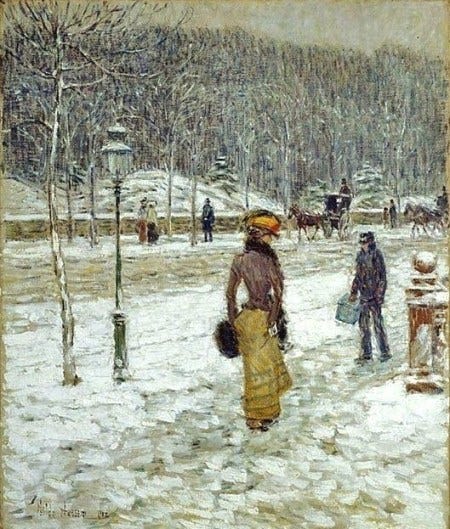
P.P.S. All the images in this post are works by the American Impressionist painter, Guy Carleton Wiggins. This is what he said about these snow scenes:
“One cold, blustering, snowy winter day (1912) I was in my New York studio trying to paint a summer landscape…Suddenly I saw what was before me—an elevated railroad track, with a train dashing madly through the whirling blizzard-like snow that made hazy and indistinct the row of buildings on the far side of the street. In a week, so to say, I was established as a painter of city winter scenes, and I found it profitable. Then suddenly I felt a revulsion against them and I stopped. . . . I couldn’t go on with winter stuff and that was all there was to it.”
THE CHAT. January 25, 2025
Hi everybody. It’s me, Ottessa. I’m writing to you from a tiny studio apt sublet in Manhattan sick in bed and desperate for your questions!!!
Ellie: Ottessa -- when you get sick, what do you do to feel better?
Ottessa: When I’m sick, I try to isolate myself like an animal in the wild.
Johnnie: About the deep connection between focus, creativity, and one’s sense of self, how do you see these elements intertwining in your life, and how important is each one to your well-being?
Ottessa: Focus is a challenge, and when it is it’s an indication that there is something irritating me outside the scope of what I actually want to focus on. Usually I need to be alone and a bit manic to focus intently on one thing for a number of days in a row. I like working like that. For me, creativity is just thinking. Focus is just paying attention. My sense of self is breathing and getting up to use the toilet. I hope that makes sense to one of you. I’m delirious.
Benji: What’s the worse piece of advice you ever got, Ottessa?
Ottessa: You know what, nobody gives me advice. I don’t think I’ve ever received advice once in my entire life.
Olivia: I loved your post about counting the steps before delving into writing and was wondering if there are any other rituals you practice before, during, or after a writing session that you might be willing to share.
Ottessa: Okay yes. I compulsively chew sugar-free Ricola. That’s one thing. Depending on the project, I drink liters of Diet Coke or tons of herbal tea (it really depends). And I stand up and stretch every twenty minutes (max) and cry out, “Oh my God, what?” I also try to kneel down and pant like a dog while I pray. TMI but you asked.
Alan: Ottessa, what are the spiritual texts that you reread?
Ottessa: That one book about the Aghori. Let me find it… At the Left Hand of God by Robert Svoboda.
N: Ok I’ve read all your books, and I always imagine them all being part of one universe-like an ‘Ottessa Moshfegh Universe.’ In my mind, Lapvona happens first, then McGlue, and the others follow. Was that something you ever thought about while
writing, or do you see them as completely separate worlds?
Ottessa: Separate worlds, same universe. “What is a universe?” I think the Ottessa Moshfegh Universe includes a very vast desert. When you go there you’re always tired and thirsty and hallucinating, and there is always someone holding a knife to your throat asking you to think of something better than the thing you thought just before. But you’re also very happy. Like ecstatically happy. And so nobody understands you. Does that make any sense?
Gwen: Hi Ottessa, I was wondering how you negotiate the ‘fate’ or prophetic nature of making your work with the hard edges of the publishing world. Do you just need luck when it comes to the muse and the publishers arriving at the same time?
Ottessa: Excellent question. Here’s my strategy: insane lust and desire and focused energy on the work, and then cruel detachment as soon as anyone but me has seen it. Like exposing a steak to air. It’s going to turn brown and start to stink. So I just cook it immediately and eat it and it’s done its job for me internally. That’s it! Publishing is a business, and I believe in synchronicity and fate as much as I believe in working harder than anyone else to get what you want, so I think it’s a combination. I don’t believe in muses actually… I’m open to the possibility that a muse can exist for a writer. But it really seems like a horny thing with art as an excuse.
Jorg: Hi Ottessa and hi to everyone! Sorry to hear you’re sick. My first question: are you feel able to read when you’re sick?
Ottessa: No! I can’t read when I’m sick. Usually I can’t read when I’m well either. But I do think that being sick is a kind of gift into a different zone of consciousness. When I had bad pneumonia and my fever went very high, it was similar to taking ayahuasca or something. I could look down at my tiny life from very high up and see how silly it is that I make myself miserable. And how funny. That’s often helpful. Who was it that said that consciousness was a disease? Dostoevsky in “Notes from Underground.”
Erasmus: Which of your senses would you be the most sad to lose?
Ottessa: Vision 100%…
Jenn: Did you ever have an ah-ha moment that leveled up your writing?
Ottessa: There are so many kinds of ah-ha moments! But I can remember this one specific moment, I had just finished graduate school, and I shared something I wrote with an old friend and she was like, “Why don’t you just write about stuff that happened?” And suddenly my life and the decisions I’d made, the stuff of my life story, kind of made sense. I had always felt I was pulling things out of thin air in fiction. And then, this stupid phrase, “stuff that happened,” made the stories I was imagining somehow palpable and possible. I think that’s when I started writing more realistically. It’s when I started writing the stories in “Homesick for Another World.”
Theo: Ottessa, if you were teaching a class on the short story what stories/collections might be on your syllabus? (Besides Garielle Lutz, which I know you’ve mentioned.)
Ottessa: Alice Munro “Wild Swans” and Eudora Welty “Why I live at the P.O.”
C: Do you still write in front of a mirror?
Ottessa: No I do not.
L: Hi Ottessa, good night from Madrid. Here, it is 10pm. I think you avoid autofiction. You still are of those writers who creates characters and plots, and don’t just tell their real life. What do you think of autofiction? Is It over? How do you choose your stories?
(Sorry for my english, sure it could be better)
Ottessa: I think the distinction between fiction and autofiction is negligible! It doesn’t matter! I think maybe people who say “I write autofiction” need more attention. And fiction writers are more willing to be invisible? But formally there is no difference.
Aloy: How do you know if you are writing something edgy to ‘be edgy’, or if you are writing something edgy because it is where your craft honestly is tugging you . . . or does not matter?
Ottessa: I truly think that once you’ve found your writing-self, you don’t worry about being edgy. You worry about following the work attentively. You don’t grasp or “try.” You work and step closer, always failing to get there, but then, finally, you’re somewhere else. About autofiction, I think it is a useful place to begin. Going back to the question about aha-moments, writing about yourself is excellent practice because we all want to seem interesting and impressive. And I think when you’re organizing a story about yourself--like recounting a dream to someone you have a crush on--you try to tell the most interesting version. You add things and bend things. You want there to be some uncanny ending. You want to appear vulnerable but magical. It’s very useful.
Lucy: Do you think the spirit can have sustained power over the body?
Ottessa: Yes, I think the spirit sustains some power over the body until the body has died. All used up. No more fun.
Nic: Since you mentioned you’re in Manhattan right now; how does the place in which you find yourself writing at any given time, effect your work?
Ottessa: If I’m in a hostile environment, my work will be defensive. If I’m in an inspiring environment, I will probably write very short things because I’m distracted. The best thing for me is to have a mix of different places, and then a refuge, a retreat, where I can be alone for many many pages and forget my life.
Tucker: The last good movie you have seen recently?
Ottessa: Mike Leigh’s new movie “Hard Truths.”
Duke: Do you worry about losing the mystique of the author by having such direct contact with your fans?
Ottessa: No. I don’t care about any of that because I never had any mystique… Also, I’m 43. Which isn’t an old lady, but old enough that I can’t pretend to be immortal. And mystique is always tied up in the fantasy of somebody not being human. No shits and farts, right? I’m actually a very goofy person. I just know how to behave and shut up from time to time, I guess. And I think that mystique is stupid now. It used to be a powerful female attribute, for example. The mysterious feminine. Well, fine, but I don’t want that on me in those terms. Somebody wanting to cultivate and air of mystique feels so bogus now. It’s empty. It’s someone saying, “Project onto me as I retreat, because I am too insecure to be myself.”
EC: Ottessa if a person was supposed to write today on their novel, but instead just keeps cleaning their house, what might you say to them to help turn it around
Ottessa: Come clean my house. Also, WHAT THE FUCK. Don’t you know that you’re going to die someday?! Fucking A. You need to write immediately. Sit down and do it.
Amanda: Have you had any cherry pie or black coffee this week?
Ottessa: No. And maybe this is why I’m not feeling well.
Pip: Do you ever go months without writing?
Ottessa: The last time I went months without writing was when I was a drunk math teacher here in New York in 2002. I didn’t write. All I did was teach math (terribly!) and drink and chainsmoke and watch my black and white TV. I never want to do that again.
Pip: What kind of math?
Ottessa: It was freshman algebra, and pre-calculus and SAT math prep for juniors and seniors.
Pip: Do you like mathematical poetry?
Ottessa: You know, I am not sure I have heard of mathematical poetry. But as a trained classical musician, maths factor into how I compose a sentence, phrase, paragraph, etc. Math is in everything. The sacred geometries, etc...
Anonymous: why did u choose the protagonist from My Year Of Rest And Relaxation to not have a name? And what do u think her name will be?
Ottessa: Names are wonderfully powerful, and every name I tried to attach to her seemed really dumb. It seemed to dumb her character down in exactly the same way she thinks everything is dumb. She needed to be nameless because she wasn’t participating in the “name game”--she was above it all. And once I just accepted that, it was fine.
Finn: Any thoughts on pretension? Is it a boogeyman?
Ottessa: Pretension was something everyone started criticizing in the 90s. If you wanted to insult somebody, you’d say they were “pretentious.” But I think pretension is maybe something you don’t need to focus on. It’s just another word for “failure.” If you’re worried that you are pretentious, think about this: Unless your narrator is a writer, there is no reason for the reader to have to pay any attention to the words on the page. They should be almost invisible. Like air. You don’t think, “Let me breathe this bit of air.” No. You just take it in, believe it is air.
Gizmo: What was the best thing about the 90s?
Ottessa: Sinead O’Conner
Coco: Is there anything of yours that you have read back that you wished you could change?
Ottessa: Hm, maybe mean emails I wrote to ex-boyfriends?
Coco: You could always send them a new draft.
Ottessa: No, that would be pathetic. Whatever you do, DON’T BE PATHETIC, am I right?
Coco: You are right. In the old days, those are the emails that were just, you know, letters. I have a box of them in my garage, because they were never sent.
Ottessa: I mean, there’s a carelessness that a writer needs. A kind of “I don’t care where this lands” when you throw a bag of rocks attitude.
THE END
This last one is by Robert Henri.
“Henri’s Snow in New York depicts ordinary brownstone apartments hemmed in by city blocks of humdrum office buildings. This calm, stable geometry adds to the hush of new-fallen snow. The exact date inscribed—March 5, 1902—implies the canvas was painted in a single session. Its on-the-spot observations and spontaneous sketchiness reveal gray slush in the traffic ruts and yellow mud on the horsecart’s wheels.”